
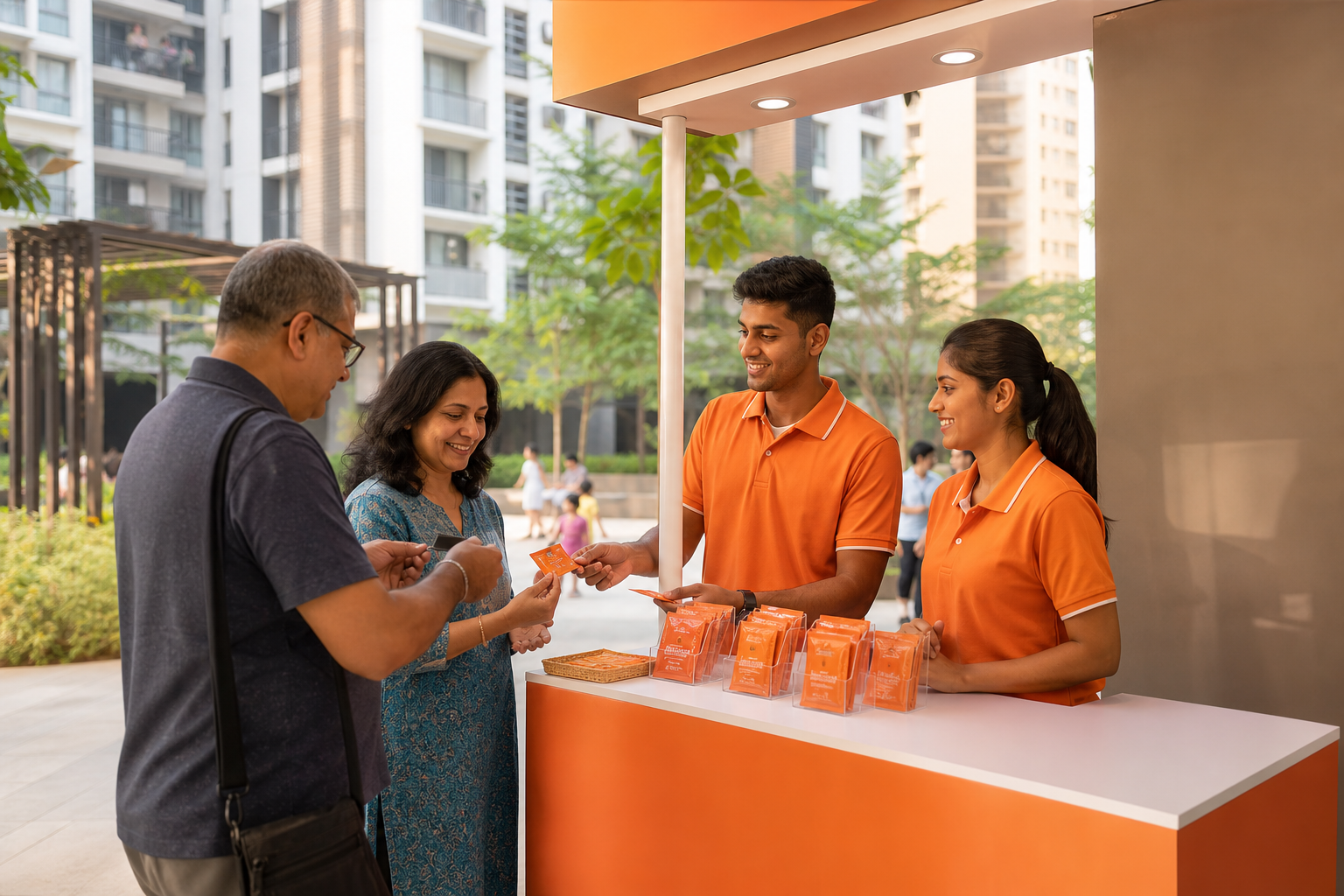
The situation
A D2C personal-care brand wants first-trial in Navi Mumbai societies before spending on a wider Mumbai Metropolitan Region rollout. The brief is not “do BTL somewhere in MMR.” It is: reach young families in Kharghar and Nerul societies over two weekends, capture structured feedback, and decide whether to expand.
This is how a use-case style activation should be planned so visitors (and brand managers) can reuse the learning.
What “good” looks like before anyone goes on ground
1. One primary metric
Pick a single success definition:
- Trial units distributed with a completed feedback card, or
- Qualified WhatsApp opt-ins, or
- Repeat-purchase intent scores
Secondary vanity metrics (photos, footfall estimates) can exist, but they should not replace the primary metric.
2. Zone roles
| Zone | Role |
|---|---|
| Kharghar societies | Weekend family trial |
| Nerul societies | Mixed weekday evening + weekend |
| Vashi | Hold for phase 2 if phase 1 converts |
Treating every pin code the same usually wastes staffing.
3. Permission checklist
Before creative is printed:
- RWA / society manager NOC window
- Allowed setup footprint and power
- Language preference on the ground (Marathi / Hindi / English)
- Sampling rules (age gates, one unit per household, waste disposal)
On-ground playbook (weekend one)
- Recce two days prior — confirm entry gate, rainy-day backup lobby, and where to stage stock.
- Team brief (30 minutes) — product claims that are allowed, objection handling, and how to fill the feedback form.
- Activation block — 3–4 hour window aligned to society footfall, not an open-ended “all day” deployment.
- Close-out — stock reconciliation, issue log (access denied, stock-out, weather), and same-day field report.
What the brand learns that photos cannot show
- Which society types convert better (tower vs plotted)
- Whether the offer needs a demo or just a sachet handout
- How many interactions a two-person team can handle without quality drop
- Whether Kharghar alone can justify phase-2 budget
What usually goes wrong in society sampling
Most society programmes that disappoint do not fail on the day. They fail in the week before, when small gaps are left for the floor team to solve. The common patterns:
- Permission is verbal, not written. The society manager agreed on the phone, but the security guard on Saturday has no instruction and the team waits at the gate.
- The time window ignores how residents move. A block scheduled when families are out, or when the courtyard is busy with children playing, produces rushed, low-quality interactions.
- Feedback is collected on paper. Cards get wet, handwriting is hard to read and nobody can tell which society a card came from by Monday.
- Stock is not reconciled per location. The brand sees a total count but cannot tell which societies actually received product.
- Photos replace reporting. A gallery of smiling promoters says nothing about whether the offer worked.
The system behind the weekend
The fix is not more people. It is a simple chain of records that every location follows, so the brand can compare one society with another.
Before go-live: a recce record per society
Each society gets one digital recce entry: gate and entry rules, the approved setup spot with photos, power if a demo needs it, a covered backup area for rain, the stock staging point and the contact who signed the NOC. If a recce is not approved, the society does not enter the beat plan.
During the block: structured data capture
Feedback is captured on a phone form rather than paper, using field data collection. Keep the form short: household type, product tried, one preference question, intent to buy and an opt-in for follow-up that records consent clearly, in line with the Digital Personal Data Protection Act, 2023. Each response is tagged to the society and time block automatically.
Through the day: one field report per location
Field reporting gives the brand a live view by location: check-in time, stock opened, issues logged and close-out. Where the brand needs GPS and time-stamped photo proof of presence, Proofield, Clogik's offline Android field app, covers staff attendance and audit photos.
Checklist for the feedback form
- No more questions than a resident will answer while holding a child or a shopping bag
- One question that maps directly to the primary metric
- Society name and time block captured automatically, not typed by the promoter
- A clear consent line before any phone number is collected
- A free-text field for the promoter's own observation
- Available in the languages agreed at the permission stage
How to measure weekend one
Compare societies on ratios, not totals. A large society will always produce more handouts; the useful question is where the offer worked best.
| Measure | What it tells you |
|---|---|
| Completed feedback per interaction | Whether the team is having real conversations or only handing out units |
| Consented opt-ins per society | Which societies are worth a follow-up offer |
| Stock issued vs stock reconciled | Whether distribution is controlled at each location |
| Issues per block (access, weather, stock-out) | Which problems are operational and fixable before weekend two |
| Preference split by society type | Whether tower and plotted societies need different offers |
Review these on the Monday after weekend one, change one thing for weekend two (time block, offer, society mix or script) and compare again. That is how two weekends become a decision instead of a slide.
How Clogik runs this use case
Clogik is based in CBD Belapur and plans society sampling with product sampling execution, digital recce before go-live, and field reporting during the weekend. Clogik's core work is event and experiential technology, so sampling runs as enablement: the systems for recce, data capture and reporting come first, and the floor team works inside them. When a society event calls for a playable moment rather than a handout, a brand activation format such as a game or an interactive wall can be added. Start from the Navi Mumbai city guide if you are scoping zones.
Takeaway
A useful blog-level lesson for marketers: society sampling is a research instrument, not only a distribution activity. Design the weekend so the dataset can decide the next city—not the other way around.
Plan an on-ground campaign
Share your objective, cities, and timeline with Clogik.
WhatsApp Clogik ↗Frequently asked questions
How do you get permission for product sampling in a Navi Mumbai housing society?
Through the society's managing committee, usually via the society manager or secretary. Ask for written approval that states the dates, time window, setup spot and what can be distributed, and share it with the security desk before the day.
What is the best time of day for society sampling?
It depends on how residents use that society. Confirm the window with the society manager during recce and run a fixed three to four hour block rather than an all-day deployment.
How many societies should a sampling pilot cover?
Enough to compare more than one society type in each zone, and few enough that every location gets a proper recce and report. The goal of a pilot is a comparison, not coverage.
How is feedback collected during society sampling?
On a short mobile form tagged to the society and time block, with consent recorded before any contact details are taken. Paper cards are hard to read and hard to attribute.
What should a brand receive after each sampling day?
A location-wise field report: attendance, stock issued and reconciled, completed feedback, consented opt-ins, issues logged and promoter notes, with photos tied to each location.
Can the same society sampling approach work outside Navi Mumbai?
Yes. The recce, data capture and field reporting steps are not tied to one city; only the permissions, languages and zone roles change.