
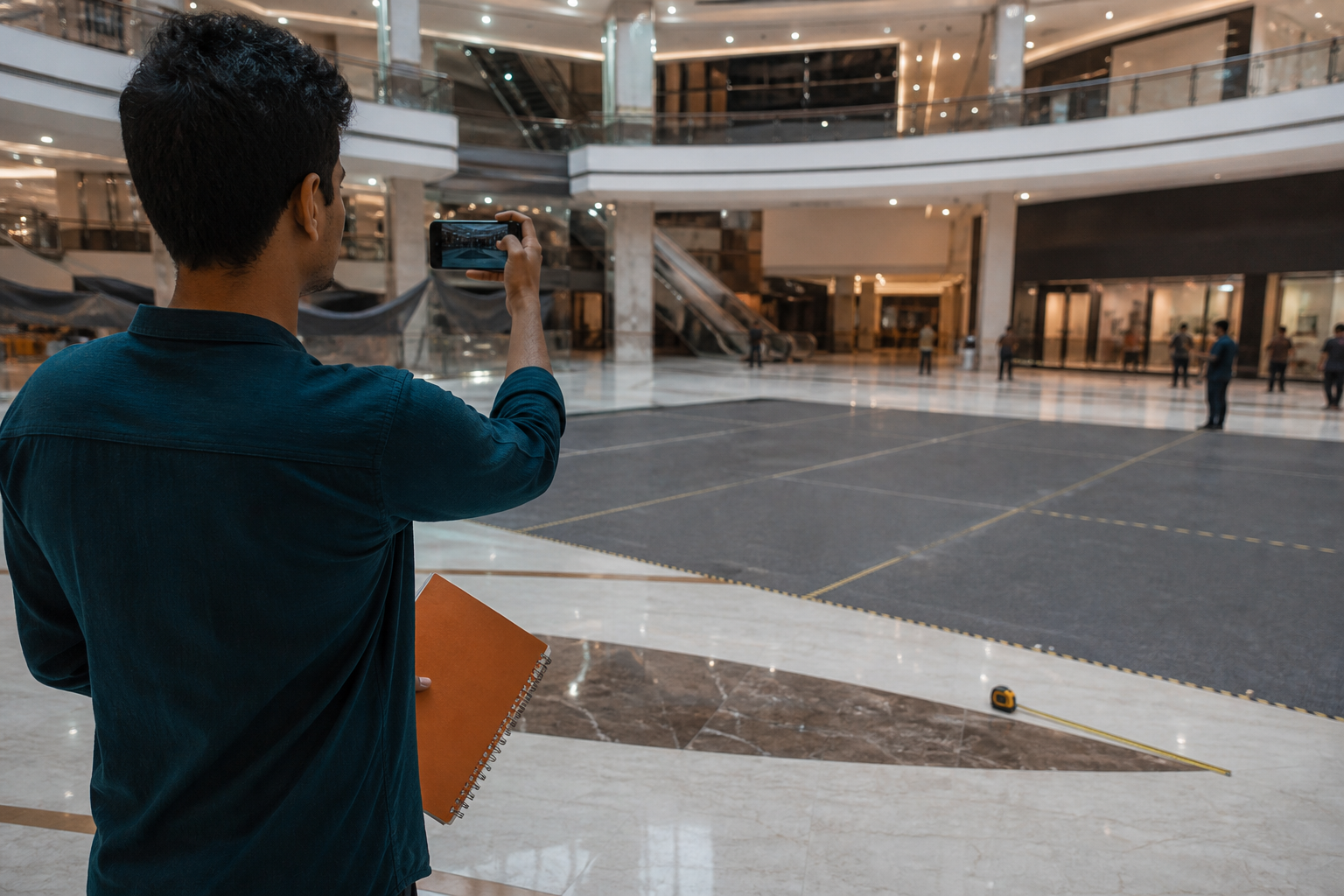
Why mall and expo recce is the same job
A digital recce app India teams can actually use is not a tourism camera. It is decision data for fabrication, electrical, and software. The venue type changes the constraints; the job does not. You still need captioned photos, GPS or stall ID, a checklist that every city fills the same way, and a status the agency can see: draft, submitted, approved.
WhatsApp galleries fail because nobody labelled which image is the power point versus the branding height limit. Spreadsheets fail because city teams invent their own columns. A recce record is QA. The cheapest fix is the one that happens before wood is cut or LED is hired.
What the app should capture every time
- Clear dimensions and height at the install point—not from a brochure
- Power type, distance, overnight access, and who may patch
- Load-in path: dock, service lift, timing window, security rules
- Queue space and neighbour clutter (mall tenant or neighbouring stand)
- Network assumption: hall Wi-Fi is not a plan; note cellular or LAN
- Permission status: mall NOC or organiser electrical form
- Backup zone if the primary court or wall hang is blocked
Anonymised mall example
An electronics launch books a centre-court weekend in a metro mall. Creatives are approved. Two days before go-live, the local team finds a temporary stage on the court and power on the opposite side of the atrium. That is not a creative problem. It is a recce that never closed.
With a structured visit, the coordinator would have logged court length, clear height, socket type, overnight access, and a backup floor option. Fabrication would have switched to a low-profile kiosk instead of a tower that could not stand. The brand would have seen one visit record instead of twenty unlabelled images. Clogik’s Recce Management System is built for that loop: mobile capture, admin review, client-visible report.
Mall-specific extras: music limits, neighbour tenants, branding-zone tape, and NOC windows that may be evenings only. If install crew can only work after 22:00, that belongs in the recce—not in a panic text on Friday.
Anonymised expo stand example
A brand pavilion at a trade show specifies a 3.5 m LED wall in the 3D. The hall soffit at that stall is 3.2 m. The organiser’s power drop is a 5A socket on the rear aisle. Neighbour stands have already built a double-decker that kills the sightline from the main corridor. None of this is visible in the organiser’s CAD until someone stands on the floor with a tape and a camera.
Expo-specific extras: dock time, vehicle height, union or organiser labour, hanging-banner rules, and whether overnight work is allowed. Interactive software still needs a network path. If you also run event registration at an inner gate, the badge printer and the wall PC share the same electrical honesty. See exhibition tech for how recce, wall, and reporting sit on the stand.
We keep examples anonymised. Live ops photos stay off this page. The pattern is what matters: one checklist, comparable cities, no invented footfall in the wrap.
Spreadsheet dump vs structured recce
| Without structured recce | With a digital recce app |
|---|---|
| Issues found on install morning | Issues found before fabrication lock |
| Arguments over which photo | One visit record with captions and status |
| City teams invent their own notes | Shared template across India |
| Wall or kiosk built to an old floor plan | Hardware follows measured height and amps |
Decision tree after submit
- If power is far or under-spec → revise electrical or move the court / stand equipment
- If height is below the render → switch to low-profile LED or projection
- If NOC or dock is evenings only → change crew shift before travel is booked
- If primary zone is blocked → activate the backup already documented
How recce feeds the rest of the stack
Recce is the first step in Clogik’s wedge: recce → registration → interactive + data → field reporting. A wall that was never recce’d will not report honest sessions. A badge printer with no overnight power will not greet dealers at 08:00. Field reporting after the show is only as good as the site facts you captured before it.
AR/VR honesty belongs here too. A playable interactive wall needs clear height, power, and a play zone. Headset theatre is a different supplier category. Do not recce for a hologram catalog if the brief is a gesture game the brand can open on Monday.
Takeaway
If the launch depends on physical space, treat recce like QA. Mall court or expo stall—the app is the same job. Capture once, approve once, build once. Clogik’s recce product is the capture layer; exhibition tech and walls sit on top when the stand must also play and report.
Plan recce before load-in
Share hall or mall, stand or court size, and show dates.
WhatsApp Clogik ↗Frequently asked questions
What is a digital recce app in India used for?
It captures site facts—power, height, load-in, captioned photos, and approval status—so mall activations and expo stands are built to the real floor, not a WhatsApp dump.
Is mall recce different from expo stand recce?
Same job, different constraints. Malls add NOCs and neighbour tenants. Expo halls add dock times, electrical forms, and aisle rules. One template should cover both.
When should recce happen relative to fabrication?
Before graphics lock and wood is cut. Issues found on install morning are the expensive kind.
Does Clogik sell only a recce app?
The Recce Management System is the capture layer. The same stack can add registration, interactive walls, exhibition tech, and field reporting.
Do you invent client scale in recce reporting?
No. Recce reports what was photographed and measured. Incomplete visits stay in draft until the checklist is filled.