
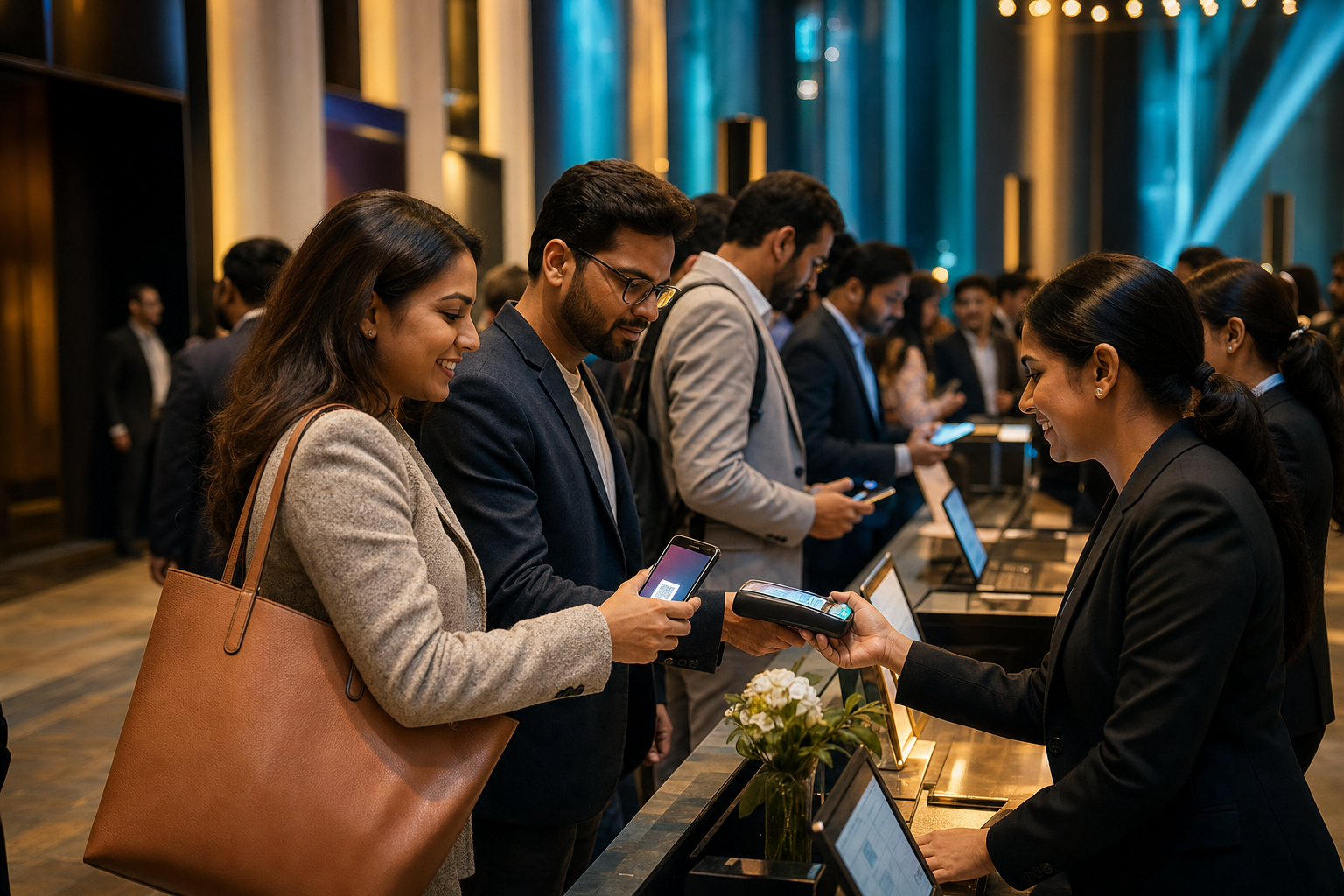
What a check-in system actually does
Registration gets people to say yes. Check-in is where the event finds out who really came. At a dealer meet, a results day, an AGM or a three-day conference, the gate is the busiest five minutes of the whole programme, and it is also the moment the organiser's data is either captured cleanly or lost to a clipboard.
A good event check-in system does five jobs in one flow:
- Identify the guest from a QR pass on their phone, a printed pass or an RFID badge.
- Mark them present against the registration list, with the time and the gate.
- Print or hand over the badge with the right name, company and category.
- Control access to halls, sessions, lounges and backstage by category.
- Report live so the organiser can see arrivals, queues and no-shows while there is still time to act.
If any of these happens on paper, the report after the event will be a guess. That is the gap to close when you compare vendors.
QR vs RFID check-in for conferences in India
Both work. The question is which fits your format, your guests and the number of doors.
QR check-in sends each guest a unique code by WhatsApp, SMS or email after registration. At the gate, a handheld scanner, a tablet or a phone app reads it in about a second. Nothing has to be manufactured, codes can be reissued instantly, and every guest already carries the device that holds the pass. The weak points are low screen brightness, cracked screens, weak mobile signal for guests who did not save the pass, and screenshots forwarded to someone who was not invited. Single-use validation (the code works once per gate) handles the last one.
RFID check-in puts a chip in the badge, card or wristband. Short-range tags (NFC/HF) need a tap on the reader; long-range tags (UHF) can be read as people walk through a gate, which is how session and hall tracking is done without a queue. RFID badges cannot be screenshotted, they work when the phone is dead, and they make re-entry and multi-day attendance quick. They cost more per attendee, need badges to be encoded and issued, and need readers installed and tested at every door.
| Factor | QR check-in | RFID check-in |
|---|---|---|
| Best for | Single-day conferences, dealer meets, AGMs, launches | Multi-day conferences, expos, several halls, session tracking |
| Pass delivery | WhatsApp, SMS or email, minutes after registration | Badge or wristband issued at the desk or couriered |
| Entry speed | Scan per guest; fast with enough lanes | Tap, or walk-through with UHF gates |
| Sharing risk | Screenshots possible; use single-use validation | Physical badge; hard to copy |
| Session / zone tracking | Needs a scan at each door | Readers log entry automatically |
| Hardware | Phones, tablets or handheld scanners | Encoded badges plus readers at every door |
| Works with a dead phone | Only with a printed pass | Yes |
Many events combine the two: a QR pass on the phone for the first entry, and an RFID badge printed and handed over at that moment for the rest of the event. For how these choices affect the budget, read what drives event registration software cost in India.
On-site badge printing: pre-printed or on demand
Pre-printed badges look tidy on the table, but they assume your list is final. In practice names are misspelt, designations change, delegates send a colleague, and walk-ins arrive with the senior team. Every one of those becomes a hand-written badge.
On-demand printing prints the badge at the second the guest is scanned. The badge always matches the latest data, the category colour and access rights are correct, and the desk does not have to sort hundreds of badges alphabetically. Plan one printer per two or three lanes, spare ribbons and stock, and a supervisor who can edit a record and reprint without calling the office. For VIPs and speakers, a small pre-printed set at a separate desk still makes sense.
Access control by zone
Corporate events in India rarely have one door. A results day has the main hall, a media room and a green room. A dealer meet has the plenary, an awards dinner and a product display. An expo has visitor, exhibitor and crew entry. Access control means mapping each category to the zones it may enter:
- Categories — delegate, VIP, speaker, media, exhibitor, crew, vendor.
- Zones — main hall, breakouts, lounge, dining, backstage, exhibition floor.
- Rules — which category enters which zone, on which day, how many times.
- Gates — a scanner or reader at each controlled door that allows, refuses and logs.
The log is the value. After the event you can say how many delegates attended the afternoon session, not just how many came through the main gate, and security has a record of who entered backstage.
Live headcount and the welcome moment
With every scan landing on one dashboard, the organiser sees registrations versus arrivals, queue build-up by gate and the no-show rate while the event is running. That is when it is useful: you can open another lane, delay the keynote by ten minutes or call the delegates who have not arrived.
The gate can also be the first experience rather than a formality. With a Welcome AI Avatar, a photo taken at registration becomes an AI avatar, and when the guest checks in the welcome wall shows their avatar and name with a branded greeting. It pairs naturally with an interactive wall inside the venue.
Data: what the organiser should get afterwards
Ask for the report format before you sign the scope. At minimum it should include:
- Registrations, check-ins, no-shows and walk-ins, by category.
- Arrival time by gate and by hour.
- Zone and session attendance, if access control was used.
- Badge reprints and edits made on site.
- Opt-in leads or consents captured, kept apart from the attendance log.
- An Excel export plus a dashboard the client can open later.
Registration and check-in collect personal data, so they fall under India's Digital Personal Data Protection Act, 2023. The DPDP Rules were notified in November 2025 with most obligations phased in over the following months, so show a clear notice and ask for consent in the registration form, collect only the fields you need, and agree with the client how long the data is kept. If you also need data from booths or field teams, see data collection.
Check-in checklist for a corporate event
- Format agreed: QR only, RFID only or QR plus RFID badge.
- Categories and zones mapped, with entry rules per day.
- Registration form with consent text and only the fields needed.
- Passes tested on WhatsApp, SMS and email, including resend.
- Lanes planned for the peak arrival window, with a VIP desk.
- Badge design approved; printers, ribbons and stock on site with spares.
- Scanners and readers tested at every door, offline mode confirmed.
- Dedicated router for the desk, not the venue Wi-Fi.
- Walk-in and edit process agreed with the client.
- Post-event report format signed off before the show.
How Clogik runs check-in (white-label for agencies)
Clogik is an experiential technology partner. Our event registration system covers online registration, QR and RFID check-in, badge printing, the Welcome AI Avatar wall and a live attendance dashboard, and we staff the desk on the day. Named work includes dealer-event registration with OTP invites for HP's "Tool se Taal", registration and lead capture for AMFI's Bharat Nivesh Yatra at the Mahakumbh, a unique QR for every exhibitor for Austrade at AAHAR 2025, and OTP SMS plus WhatsApp registration for VI-JOHN. When an event needs its own flow, our custom software team builds it. For agencies we work white-label: you keep the client and the billing, we build and run under your brand. Sales, support and tech are available 24×7.
Planning registration and check-in for your next event?
Send the event type, expected headcount, number of days and halls, and the cities. We will suggest QR, RFID or both, the badge and access plan, and the report you will get.
WhatsApp Clogik ↗ Request a call back ↗Frequently asked questions
What is an event check-in system?
Software and hardware that confirms a registered guest at the gate with a QR pass or RFID badge, prints the badge if needed and shows live headcount on a dashboard.
Is QR or RFID better for check-in at a corporate event in India?
QR for most single-day conferences, dealer meets and AGMs. RFID for multi-day events, several halls or session tracking, where taps or walk-through reads beat scanning.
Can badges be printed on site at check-in?
Yes. On-demand printing prints the badge as the guest is scanned, so details are current and walk-ins can be added.
How does access control by zone work at an event?
Each category is mapped to the zones it may enter. Scanners at each door allow or refuse entry and log the time.
Does event check-in need internet at the venue?
Scanners should work offline and sync later. Dashboards, WhatsApp passes and reprints need a link, so use a dedicated router.
What data does the organiser get after the event?
Registrations versus check-ins, arrivals by gate and hour, no-shows, walk-ins, zone attendance and reprints, collected with consent under the DPDP Act, 2023.
What is a Welcome AI Avatar at check-in?
A registration photo becomes an AI avatar that appears on the welcome wall with the guest's name as they check in.
Can an agency white-label Clogik's check-in system?
Yes. You keep the client and billing; we set up and run registration, check-in and reporting under your brand, with 24×7 support.